

Executive Summary
As AI rapidly automates the “mundane” aspects of presales from RFP responses to high-level demos, the role of the Sales Engineer is shifting from a technical resource to a strategic sherpa. While algorithms can summarize discovery calls and manage handoffs, they struggle to navigate complex technical environments and human dynamics inherent in a Proof of Concept (POC). This post explores why the POC remains “Mt. Everest” for human expertise and how SEs can leverage AI to focus on what closes deals: building buyer trust.
A Worthy Sherpa
It is perfectly reasonable to be skeptical that AI is coming for SEs, particularly in enterprise sales. There are a lot of different things SEs do: technical discovery, RFP responses, tailored demos, POCs, and handoff to post-sales, to name a few. AI is already taking on some of them directly. But seasoned Sales and Presales leaders know that, ultimately, people buy from people*. Some of those responsibilities lend themselves to SEs proving themselves a worthy sherpa, while others do not, and those that do not are most ripe for disruption from AI.
* of course, if you have a low-ticket product, you can sell it without salespeople, but you don’t because you wouldn’t be reading this otherwise
Technical Discovery
This varies from company to company, as all things do these days. Some companies rely on AEs to do all discovery without an SE to protect SE time; other companies require SEs to be part of discovery to inform their demo preparation directly from the prospect rather than filtered through an AE. AI note taking has already revolutionized one of the most mundane tasks that often fell to the SE on the team. Good AI summaries can get an SE up to speed in minutes instead of having to watch a full 30-60 minute call recording.
RFPs
Responding to an RFP used to be one of the most time-consuming and repetitive tasks assigned to SEs (also morale-depleting, especially if you come to find your company was column fodder all along). Already, they can be finished in minutes with a generative AI-powered RFP response solution, or by quickly wiring up a home grown solution that leverages past responses to RFPs. You’d be hard pressed to find a case of an SE who became a “trusted advisor” to a prospect based solely on their written responses to an RFP. This will be even more rare in a world of AI-answered RFPs. RIP to the joy of spending days filling out a 100+ row Excel spreadsheet with 1-3 sentence answers, ¾ of which you just wrote a month before for a different RFP.
Demos
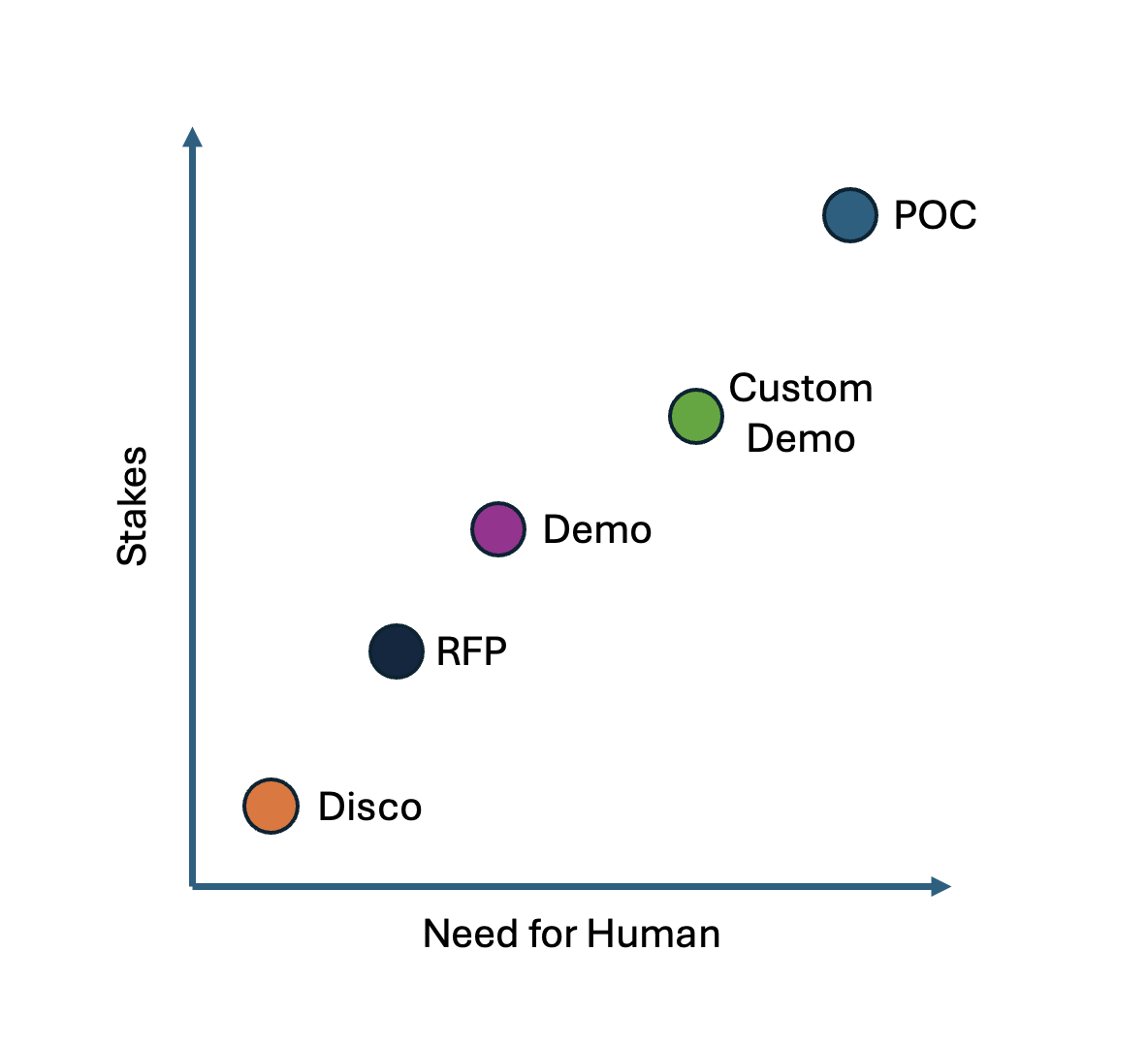
Demos will always be a focal point for SEs. If you subscribe to Consensus’ six types of software demos, video and product tours have already come for the top-of-funnel via the 5-7 minute Vision demo and the 10-12 minute Micro demo. By this time next year, AI-powered video avatars will be performing dynamic Qualifying/Discovery demos as well.
While AI agents will replace early, high-level demos, the path to revenue for the SE remains personal. Technical wins are earned through highly tailored demos based on an SE’s deep understanding of a prospect’s business. These sessions provide the stage for the SE to build rapport, demonstrate domain expertise, and tie specific features to the prospect’s unique business outcomes. And it’s here where technical wins are earned and lead to “Closed-Won” revenue.
Post-Sales Handoff
As for the always fraught pre-sales to post-sales handoff, AI can already summarize months of calls, emails, and documents to prepare a Customer Success Manager better than the average sales team whose attention has already moved on to the next deal.
What haven’t we mentioned? POCs.
Technical Evaluations: POCs/POVs/Workshops
POCs are where the rubber meets the road, and the combination of their importance and complexity make it unlikely that AI can swoop in and take over most of the work.
Let’s start with the implementation. Whereas demos are set up in clean environments optimized for the software to run smoothly, such is never the case with a prospect’s real environment. Even if they’re confining it to a sandbox or development environment. Integrations that are “out of the box” often require complicated configuration based on how the prospect has customized their implementation of the system being integrated.
There needs to be some training. It may not fall to the SE to make the prospect an expert on every aspect of the product, but if their instinct is just to email a link to the documentation, it’s likely the product won’t get used during the pilot period. Subsequently, everyone’s time is wasted. In-app, AI-powered product help is great, but you know what’s even better? A knowledgeable human who has learned what is important to you. Hand-holding you through key features you want to test during the pilot so you can make a confident decision.
Then, there’s troubleshooting. Every SE knows to avoid thorny product areas in a demo where they control the clickpath. In a POC, the prospect will be navigating the solution on their own, choosing where they want to go and when. It’s hard to imagine AI having the dexterity to work with the user to avoid those areas or deftly offer a workaround.
A Place for AI in POCs
That said, there are opportunities within the POC process for agents to assist SEs. Note-taking and call recording AI that extracts key points, identifies action items, and automatically updates the CRM are huge time-savers. In addition, agents can now proactively work with prospects to help keep the POC on track. AI also helps during the POC by eliminating mundane, time consuming tasks allowing SEs to focus on the value points of the POC; building relationships, nurturing buyer trust, guiding the evaluation (as a good sherpa should!) and focusing on the deals that matter most.
Conclusion: People Buy From People
The POC is not just a proof of the product’s capabilities; it’s also a test of the sales team’s ability to instill confidence in the buying committee that it’s making the right decision. AI can assist, but humans have to lead because for now, and most likely in the future, when there is a complex sale, people buy from people.
What makes the POC enduring is that it unfolds in the messy reality of a customer’s environment, where technical nuance and business context matter as much as product capability. In those moments, buyers aren’t just evaluating software they’re evaluating the people guiding them through the evaluation. And as AI automates more of the earlier stages of the sales process, the human moments inside the POC may become even more important and strategic, not less.
Are you using AI to be a better sherpa, or are you still stuck with the mundane? Let Provarity Instynx guide you to the top.